

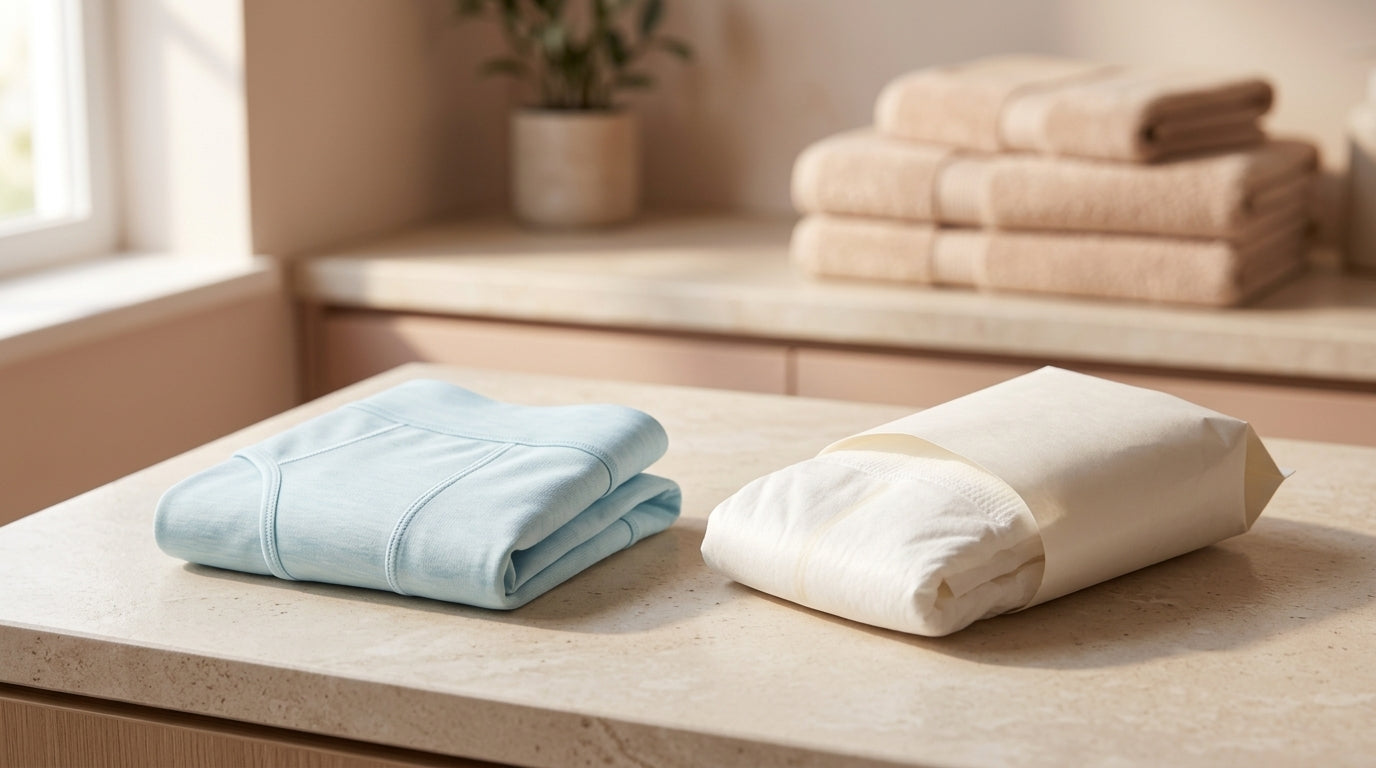
Reusable period underwear is the better everyday choice in 2026 if you have reliable access to washing and drying. Disposable period underwear is better as an occasional backup when laundry is not practical. The real difference is not simply “green versus convenient” — it is repeated use, fit, care, waste and what works on your heaviest days.
In short: reusable period underwear wins for regular use; disposable period underwear works best for travel and emergencies; protection depends more on fit and absorbency than the format; wash reusable pairs at 30°C, skip fabric softener and air-dry them.
Why this matters in 2026
Disposable period underwear is absorbent underwear intended to be discarded after use. Reusable period underwear is a washable textile product with an absorbent core and a leak-resistant barrier. Both can be useful, but they solve different problems.
The practical questions are how often you will use it, whether you can wash it correctly and whether you need a single-use option for a specific situation.
Floena’s verdict for 2026: choose reusable period underwear as your normal system and keep disposable underwear only for genuine no-laundry days.
Disposable vs reusable period underwear at a glance
| Question | Disposable | Reusable |
|---|---|---|
| Main use | One wear, then discard | Wear, wash and use again |
| Routine | Replace after every use | Rinse, wash and air-dry |
| Waste | New product and packaging each use | Laundry impact, but fewer discarded products |
| Best for | Emergencies, travel, limited laundry access | Regular cycles, home, work and sleep |
What is disposable period underwear?
Disposable period underwear is a single-use absorbent garment, also sold as disposable period panties. It is worn like underwear, but its construction is closer to an absorbent hygiene product: a soft body-facing layer, an absorbent core and a leak-resistant outer section.
It can make sense when changing a pad is difficult, when you are travelling with limited washing access or when you want a sealed backup in a work, school or hospital bag. The drawback is built into the design: every use creates another item to buy, pack and throw away.
Disposable does not automatically mean more absorbent. Check the manufacturer’s stated flow level, sizing and changing guidance. A loose leg opening or a saturated core can leak regardless of how thick the product looks.
What is reusable period underwear?
Reusable period underwear looks and moves more like standard underwear. The gusset contains layers that draw in fluid, hold it away from the skin and help prevent transfer to clothing. Different cuts cover light days, heavy flow, sleep and movement.
A reusable pair only becomes the lower-waste option when you actually reuse it. That means buying a fit you will wear, following the care label and rotating enough pairs so each one dries fully before the next use.
Floena’s Leakproof Bamboo High Waist Brief is one example: its store description lists bamboo fabric and absorbency equivalent to 3–4 regular tampons or pads. That number is a product specification, not a universal rule for all reusable underwear.
Which protects better against leaks?
Neither format wins automatically. Leak protection comes down to four things:
- Correct size: the gusset and leg openings need close contact without digging in.
- Suitable absorbency: light-flow underwear is not a heavy-night product.
- Coverage: a longer absorbent zone helps when you sleep or move a lot.
- Timely changing: every absorbent product has a limit.
Reusable underwear has an advantage in choice. You can pick high-waist, bikini, seamless, sleep-short and swim styles rather than accepting one disposable silhouette. Disposable underwear can still be the calmer option when washing a used pair is impossible.
For very heavy flow, track how long your current protection lasts on your heaviest day and carry a backup. If bleeding suddenly becomes much heavier than usual, seek medical advice rather than solving a new health change only with a higher-absorbency product.
Which costs less over time?
Reusable period underwear usually has the stronger long-term cost logic because you pay for the pair and then wash it. Disposable underwear turns every wear into another purchase.
- Count how many disposable pairs you would use in one cycle.
- Multiply that by your local price per pair.
- Multiply by the number of cycles you expect in one year.
- Compare that annual total with the cost of a reusable rotation plus washing.
Do not use a one-pair-replaces-everything calculation. Most people need several pairs, and heavy days may require a higher-absorbency option or a second form of protection.
Which creates less waste?
The evidence favours reuse. A 2022 peer-reviewed life-cycle assessment compared disposable tampons and pads with reusable pads, underwear and cups over one year, across eight environmental indicators and three countries. Reusable menstrual products had significantly lower environmental impacts; menstrual underwear ranked second-lowest after menstrual cups in that study.
Washing temperature, drying method, electricity mix and how long you keep each pair all affect the footprint. The study does not prove that every reusable product beats every disposable option in every household. Its practical lesson is narrower: repeated reuse lowers impact when the product lasts and the washing routine is efficient.
Which is easier day to day?
Disposable is easier when laundry is the problem
- you are travelling without a washing machine;
- you need an unopened emergency item;
- you cannot carry a damp used pair;
- illness, recovery or mobility makes laundry difficult.
Reusable is easier once the routine is normal
- you want underwear-like comfort through regular cycles;
- you can rinse and wash at home;
- you prefer several cuts and absorbency levels;
- you want to reduce repeat purchases.
Neither choice is a moral test. A mostly reusable system with one disposable backup is still a reusable system.
How to make reusable period underwear last
Fabric softener can coat absorbent fibres, and high heat can weaken the leak-resistant layer.
- Rinse in cold water after use.
- Wash at 30°C.
- Use mild detergent.
- Skip fabric softener and bleach.
- Air-dry instead of using high heat.
Read the complete period underwear washing guide before your first wash. Care labels always take priority because materials and construction differ between brands.
What should you check before buying?
Absorbency stated in plain terms
Look for a flow level or tested capacity you can understand. Avoid choosing only by the word “heavy”, because brands do not all use that label in the same way.
Coverage front and back
The absorbent area matters as much as capacity. Side sleepers and people who move at night often need more rear coverage than a daytime bikini offers.
Materials and testing information
Read the fibre composition and available testing information. Reusable underwear usually combines a body fabric, absorbent layers, elastic and a leak-resistant membrane.
A realistic rotation
Plan around drying time. If you use two pairs on a heavy day and air-drying takes overnight, one pair cannot cover a full cycle by itself.
When a mixed system makes sense
For many people, the most practical system is reusable period underwear for predictable days plus a small disposable reserve for situations without washing access. Test a new pair at home first. Check the fit at the waist and legs, learn your personal changing interval and build your rotation from what you actually use.
Frequently asked questions
Is reusable period underwear better than disposable?
It is better for regular use when you can wash and dry it correctly. Disposable period underwear is better for occasional situations where laundry or carrying a used pair is impractical.
Can disposable period underwear handle heavy flow?
Some products are designed for heavier flow, but the label, fit and changing interval matter. Thickness alone does not guarantee leak protection.
How many reusable pairs do I need?
You need enough pairs to cover wear, washing and drying across your cycle. Start from your heaviest day and count how many changes you normally make.
Can I use both disposable and reusable period underwear?
Yes. A reusable main rotation with a disposable emergency backup is a practical mixed system for travel, school, work or recovery.
One last thing
The best product is the one you can use correctly every cycle. In 2026, reusable period underwear wins the overall comparison, but keeping one disposable backup can remove the only real weakness of reuse: laundry is not always available.
Related guides: which reusable period products are worth it, period underwear for heavy flow and Floena menstrual underwear.


